
Industry 4.0 was announced back in 2011. More than a decade later, most manufacturers are still stuck somewhere between pilots and promises. Not because the technology isn’t there, but because we fell into three traps.
Key Takeaways
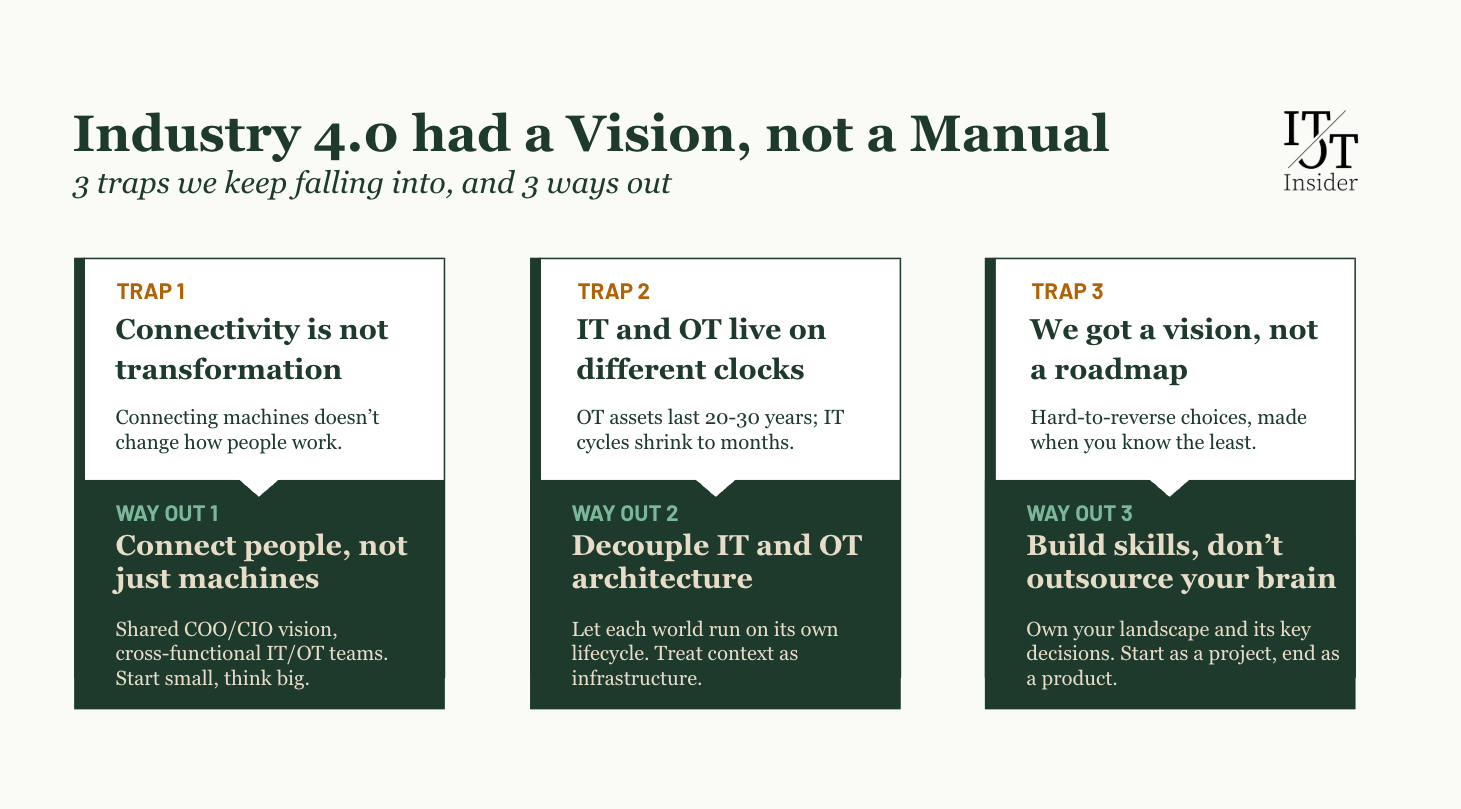
- We confused connectivity with transformation: connecting machines is not the same as changing the way people work.
- IT and OT live on different clocks. OT assets last 20 to 30 years, IT lifecycles are measured in months. Accept it and design for it.
- Industry 4.0 gave us a vision, not a roadmap. Start from the problems you want to solve and treat architecture as the set of choices that are hard to reverse.
- The way out: connect people instead of only systems, decouple your IT and OT architecture, and build the skills in-house instead of outsourcing your brain.
The Three Traps
Trap 1: We confused connectivity with transformation
The early focus of most Industry 4.0 programmes was on connecting things: a new wireless IoT sensor here, a connectivity project there. Visible, tangible, and easy to put in a business case.
But connecting machines is not the same as changing the way people work. A dashboard on its own doesn’t translate into lower costs or better products. Data availability doesn’t create accountability, ownership or process redesign.
Connectivity is simply a lot easier to sell than change. It’s also more exciting to talk about the new stuff. Change doesn’t sound very sexy. It sounds like hard work, and that’s because it is.
We see this in our own work too. Whether it’s in the Academy or in workshops, people almost always walk in with a technology question first. The change question comes later, if it comes at all.
Trap 2: We ignored that IT and OT live on different clocks
Nothing new here, but it keeps biting us. OT lifecycles span decades: 20 to 30 years for many assets isn’t unusual. Qualification, safety, uptime and vendor support all mean you don’t swap out a control system just because a newer version came out. Meanwhile, IT lifecycles keep getting shorter. We used to talk in years; now it’s sometimes months.
And the lower you go in the Purdue model (or whatever you prefer to draw instead of a pyramid), the slower the lifecycle. That’s very hard to change, so you need to accept it.
Now picture your shiny new AI tool that needs to talk to a 30-year-old legacy system. Exactly.
Industry 4.0 never really tackled this tension between fast and slow lifecycles, or the very different priorities that come with them. The good news: there are ways to work around it. We’ll get there.
Trap 3: We got a vision, not a roadmap
There is no standard five- or ten-step plan to go from a disconnected to a fully digitalised, integrated shop floor. So where do you start? There are so many solutions and technologies. Some vendors promise a complete ecosystem; others offer a very well-designed point solution for one specific problem.
It all boils down to knowing which problems you want to solve on the shop floor. And no, “connecting systems” is not the answer. It’s a step towards it at best.
The other half of the answer is architecture. Willem has a habit of asking every architect he meets how they define architecture. Each one gives a different answer. Our favourite comes from Martin Fowler: architecture is about the important stuff, whatever that is. You need to define what that important stuff is for your company, because it won’t be the same as for anyone else.
In practice, architecture is the set of choices that are hard to reverse. You’ll often live with them for ten or even twenty years, because migrations are expensive. And here’s the cruel part: you have to make those choices at the very start, exactly when you know the least. Get them wrong, and you find out the hard way:
- Your data is stuck and can’t be integrated into your enterprise data strategy.
- Your vendor’s portfolio turns out not to follow your use cases as your needs evolve.
- You’re expected to keep pace with technology (AI being the obvious example) but you don’t have the flexibility to do that quickly and efficiently.
That last one matters more every month. Change moves so fast now that you can’t start a two-year project and hope for the best; by the time it’s finished, it’s outdated. The end goal is a moving target. So it’s not about implementing the right architecture in one go. It’s about building in the flexibility to keep changing, for needs you don’t even know about yet.
We noticed how confusing this is for many people. When we started the ITOT.Academy, architecture was only a small piece. The feedback from our first hundred students was crystal clear: give us more. More architecture, more insight into how vendors fit into the landscape, more guidance on running an architecture workshop yourself. That’s why we now have two full sessions on data architecture.
How to Avoid the Traps
1. More connectivity, but between people
Our first trap was too much focus on connectivity. The solution? More connectivity. Just of a very different kind.
What’s missing in most organisations is the connective tissue between IT and OT. It’s the soft side, and it’s exactly what makes the difference when it comes to digitalising production. In the end, this is a management problem, not a technology problem. We explain why in What is IT/OT Convergence?
It starts at the top. Your COO and CIO (or whatever those roles are called in your company) need to share a vision and truly commit to it. If they don’t, don’t waste your time. Changing an entire company from the bottom up is incredibly hard.
Then comes the next mistake. “Great, we have a mandate. Now you shall work together. Or else.” We know how that goes. Cooperation isn’t an on/off switch. It takes deliberate organisational design: cross-functional teams where both IT and OT own the outcome, and a conscious choice about how they cooperate. That’s exactly why we developed our cooperation patterns, which we describe in detail in The IT/OT Handbook.
Trying to do this alone is the number one mistake we see. If you have one year for your project, you’re far better off spending six months building that shared vision and approach, and six months delivering, than spending a full year moving alone.
And start small, but think big. Neither is optional. Don’t attempt a marathon if you’ve never run a 5K. Small projects bring early wins, but more importantly, they are training in cooperation. Much better to learn that in a low-stakes environment than in your major transformation. Pick that first use case strategically: one that delivers fast success but can grow quickly, and that lays the foundation of your architecture so the next use case becomes easier. Yes, it’s a bit slower. The investment will pay off. And if your management doesn’t understand that, just don’t tell them. They won’t notice.
2. Decouple your IT and OT architecture
Connecting people: yes, absolutely. Tightly coupling systems: a big fat no.
We’ve lost count of the AI start-ups that proudly tell us they can connect to every machine we have. All they need is a REST API, or OPC UA. Unfortunately, most of our machines don’t speak REST. Or even better: “It works great, as long as you send your data to our API endpoint.” How you make that happen is your problem.
IT/OT convergence doesn’t mean both worlds should become the same. They’re not, and they never will be. So stop trying to turn OT into IT, or the other way round. Instead, design your architecture so that IT and OT can each grow according to their own needs and their own lifecycles. (We wrote an article on IT/OT Convergence, with a video you really have to take a look at!)
That is exactly what a modern operational data platform is for. It’s the technical bridge between both worlds. On one side you have connectivity to the shop floor. At the heart of the platform sits contextualisation: ontologies and an understanding of the physical manufacturing world, which is still not that common in IT. And on the other side, connectivity to the rest of the world. We walk through it in detail in our Industrial Data Platform Capability Map video.
Which brings us to the point we’d underline twice: treat context as infrastructure. Context is what turns data into profit. Without it, your dashboards, workflows and AI applications won’t scale beyond the pilot phase. Build it once, as a foundation, not again and again for every one-off.
3. Build the skills, don’t outsource your brain
You don’t need 1,500 experts in every tiny domain. But you do need a couple of good people who can make the right decisions, because architecture is about the stuff that’s hard to change. Without the skills, you’ll choose the wrong thing.
Which skills? Not necessarily understanding a specific protocol. That’s easy to outsource. What matters most:
- Understanding the problem you’re trying to solve. No matter how fancy the tool, if it doesn’t help anybody, it’s a waste of money. We do this for the people on the shop floor, not for the technology.
- Translating that problem into technology and architecture. If you sit between IT and OT and you don’t do it, who will? You can’t make architectural choices you’ll live with for years, sometimes decades, based on sales pitches and pretty slides.
Can you outsource that? Partly. But ask yourself who the people making those decisions for you are working for, and whether they’ll still be around. Not for months, but for years. Of course the vendor will send an architect, but their goal is to sell more of their own products, and that’s not necessarily your goal. Outsourcing this is dangerous, and as complexity grows it becomes impossible. This is permanent work, not a one-off. And these choices make the difference between a system that evolves quickly and an expensive disaster of a project that never delivers.
- The skills to execute. A good partner, integrator or vendor with experience in your problem space is key. But they can’t take on every responsibility. You need your own people to go in, make the change happen, and navigate internal politics. That part you simply cannot outsource.
Two principles follow from this:
- Start as a project, but end as a product. You need long-lived expert teams, not a series of one-offs. Treating digital as a string of projects is a mistake that can cost organisations millions.
- Own your landscape. If you want to move at the speed of IT, you need to own and understand your architecture, and have the freedom to adapt it. If your vendor is the only one who understands your landscape, you won’t get far. Bridging the gap between the sales pitch and reality takes a lot of work and expertise.
People, technology and architecture: together, that’s what gives you the skill to execute.
Final Thoughts: Drop the 4.0
Maybe it’s time to drop the name altogether. “Industry 4.0” was a label for digitalisation in production back in 2011. It was never a destination. Technology has changed enormously since then, and honestly, we’re a lot further than we were.
But contextualising and connecting everything in a seamless and secure way is simply hard. Don’t give up, especially not now that AI is speeding everything up. Stop now and you’ll be left in the dust by competitors around the world.
Instead, get better at the boring things:
- Architecture
- (Product) ownership
- Lifecycle management
- IT/OT cooperation, to deliver the right thing the right way
Go Deeper
We’ve put everything we’ve learned about IT/OT cooperation, from the Purdue Model to cooperation patterns to building an industrial data platform, into The IT/OT Handbook, published by IT Revolution Press.
And if you want to go further into data architecture, cooperation models and the practical frameworks behind all of this, check out ITOT.Academy, our live, vendor-neutral course for IT and OT professionals.