
IT/OT Builds · Playgrounds
Our IT/OT Insider Playgrounds
We have built a bakery, a chemical plant and a hydro dam for you to play with. Three simulated plants, free on GitHub, that run on your own laptop.
Why we built them
Learning by doing needs a plant
You can’t learn IT/OT from slides alone. But nobody lets you experiment on a running production line, and vendor demos only show you the happy path.
So we built our own plants. We use them in the IT/OT Academy, in our IT/OT Builds and in our Industrial AI demos. Each one has its own stack, its own data model and its own problems to solve, and you are free to use them all.
The chemical plant
Haltenberg Chemische Werke
An air separation unit (about 1,000 tonnes of oxygen a day) simulated in real time, run by a small but complete DCS with a built-in historian. There are two more sites, in Texas and Gujarat, each presenting its data in its own way.
What it teaches: The classic process-industry stack: field I/O over Modbus, a DCS with controllers and interlocks, a historian, and OPC UA as the door to IT. Then a global DataOps exercise: map three different sites onto one ISA-95 standard model.
- DCS
- Historian
- OPC UA
- Modbus TCP
- Node-RED
- Instructor station
The bakery
Sweet Harmony Treats
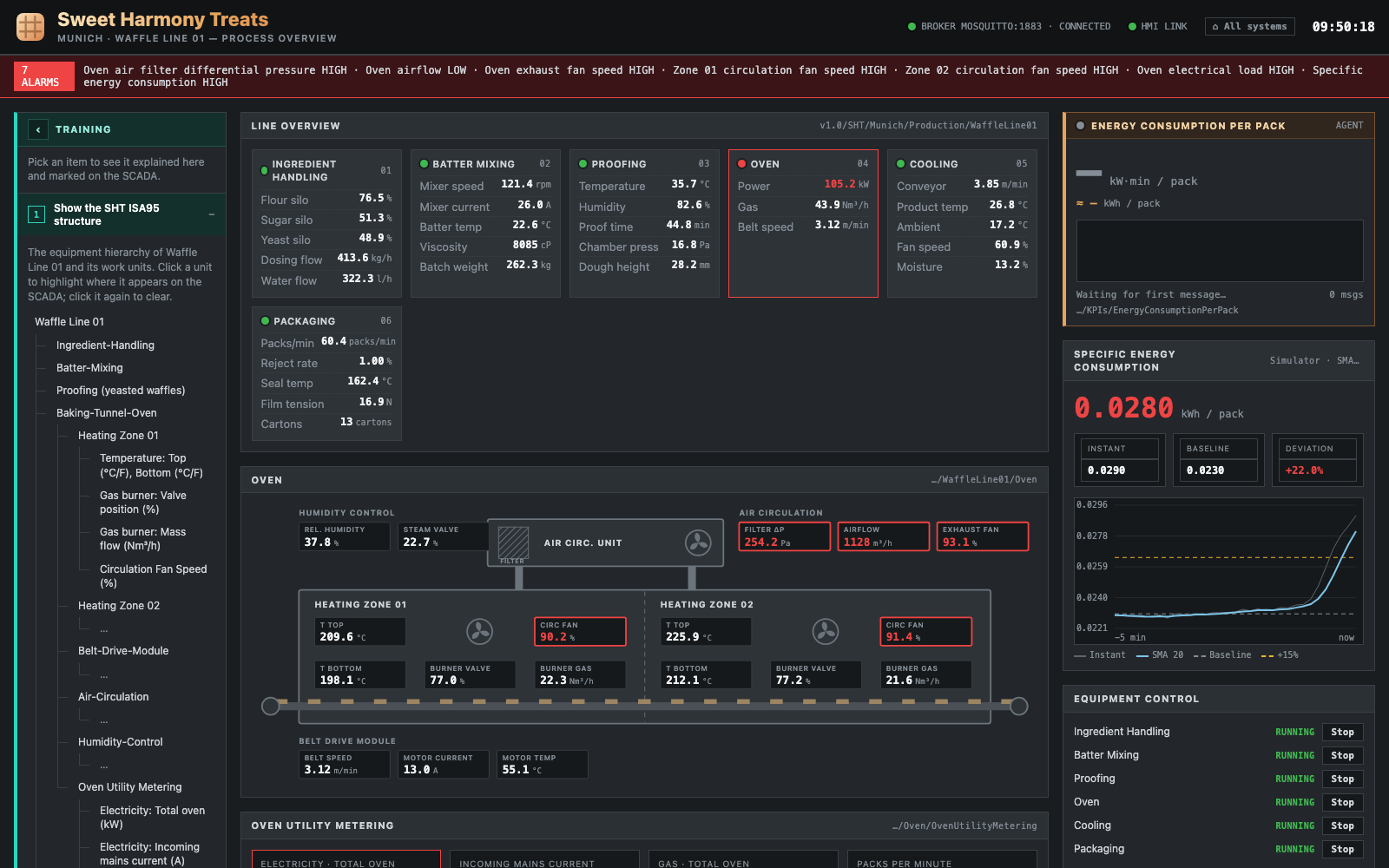
A waffle production line in Munich that publishes around 46 process values every five seconds, with a SCADA-style HMI, a quality lab, an MES and a maintenance system. One button injects a reproducible energy anomaly.
What it teaches: The Unified Namespace from the plant owner’s side: process data, maintenance orders and quality results from separate systems, published into one ISA-95-structured MQTT topic tree.
- MQTT
- Unified Namespace
- HMI
- MES
- Node-RED
- MQTT Explorer
The hydro dam
Copper Canyon Dam
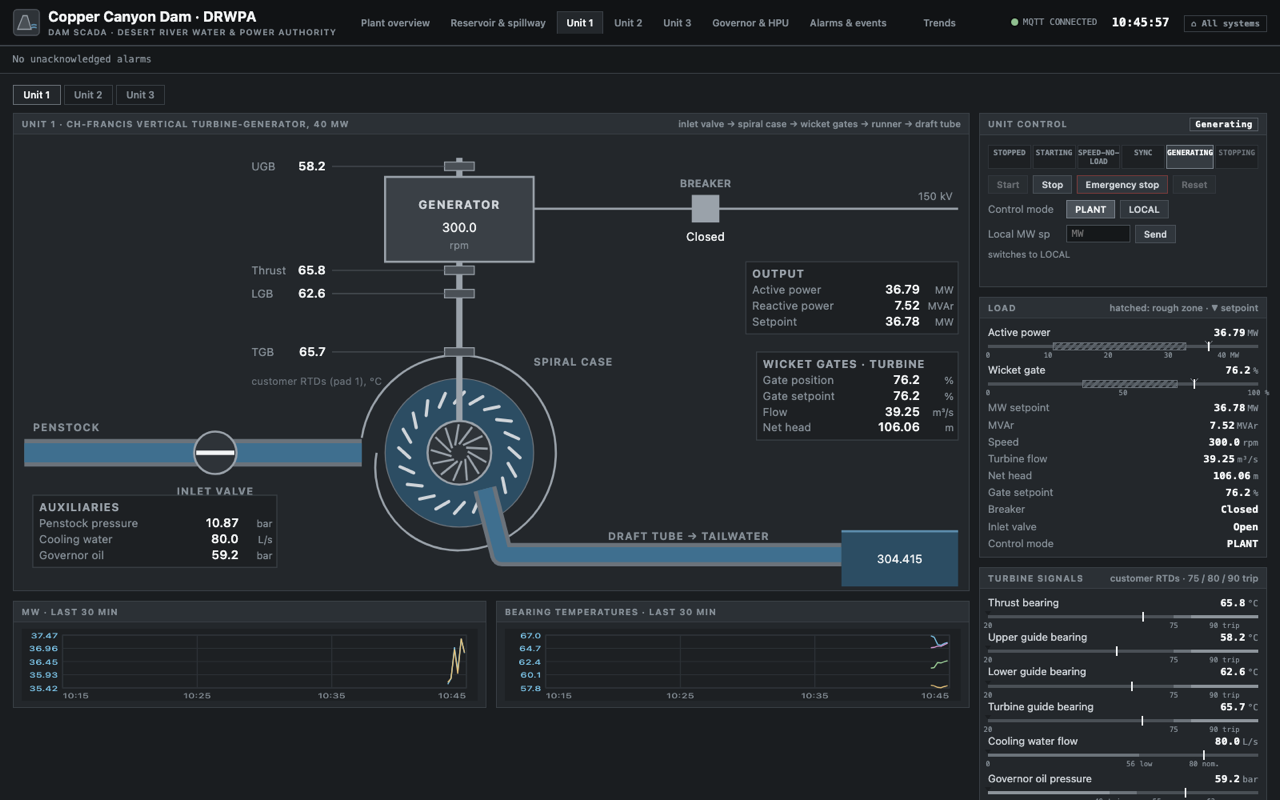
A small hydropower dam with three Francis turbines, built by the fictional machine builder Cromley Hydraulics. Every turbine has a modern PLC that publishes clean, well-structured data to one MQTT broker. An instructor station hides fault scenarios for you to find.
What it teaches: The machine builder’s view: an asset-centric OEM data model, keyed by serial number, next to the customer’s own ISA-95 tree. Rich enough to show predictive maintenance, and to run an AI-assisted root cause analysis.
- MQTT
- SCADA
- OEM asset model
- Node-RED
- MQTT Explorer
- Instructor station
This is the dam behind our Virtual Maintenance Engineer.
Getting started
Up and running in minutes
All you need is Docker Desktop (or Docker Engine with Compose). Clone a repository and start the whole plant with one command:
docker compose up -d --buildOr open Claude Code in the folder and ask it to read the CLAUDE.md file and README.md file and set up the environment. Each plant then opens a hub page that links to all its systems. Every wiki has a beginner’s guide if you have never been on a production site.
⚠️ For learning and demos only. These are generated, simulated systems. Don’t connect them to real equipment, run them in production, or base any real control, quality or maintenance decision on them.
★ Workshops
Code with us and your management team
It’s fun to see what is possible. It’s better to try it yourself. We run workshops for you and your management team: we build together, and get amazed together. In our interactive workshop we show you the power of AI, and then ground it all in what it really takes:
Do now
1. Experiment
- Use our examples and data as inspiration
- Experiment on the company GPT with real data (if allowed)
- Learn where AI tools help most, and where they are weak
Explore
2. Organize
- Work and learn together in communities, centres of excellence and the like
- Create central, chat-based solutions first
- IT won’t make your business case!
Do next
3. Cooperate
- Start a cross-functional team with IT/AI and Maintenance
- Invite them to the shop floor
- Learn more about how cooperation works
All done by the authors of The IT/OT Handbook and the IT/OT Academy.