
The digital revolution has transformed many industries, yet manufacturing and critical infrastructure continue to lag behind. Compared to sectors like finance or retail, which have rapidly embraced digital technologies, manufacturing remains deeply rooted in legacy processes. The term “Manu-Factura” (Latin for “to produce by hand”) has become increasingly outdated, but the shift toward full digital integration is proving to be slow and uneven.
At this point, digital transformation is not just a competitive advantage, it’s becoming a necessity for survival. The global landscape demands increased productivity, higher efficiency, agility, and data-driven decision-making, yet many manufacturers struggle to adapt. The industry has been talking about becoming more competitive through digital technologies for over a decade, but the results on the field have been underwhelming.
Industry 4.0, for example, has been on and off the radar of most manufacturing companies since the term was coined in 2011. While there have been some early successes, the reality is that most transformations start well but lose steam as they scale up.
The numbers paint a stark picture. Publicly available data, such as those from the Federal Reserve Economic Data (FRED), indicate that the manufacturing sector continues to struggle despite ongoing digitalization efforts. If digital transformation is the key to competitiveness, why are so many companies failing to achieve meaningful results? The answer lies not just in technology but in leadership, culture, and execution.
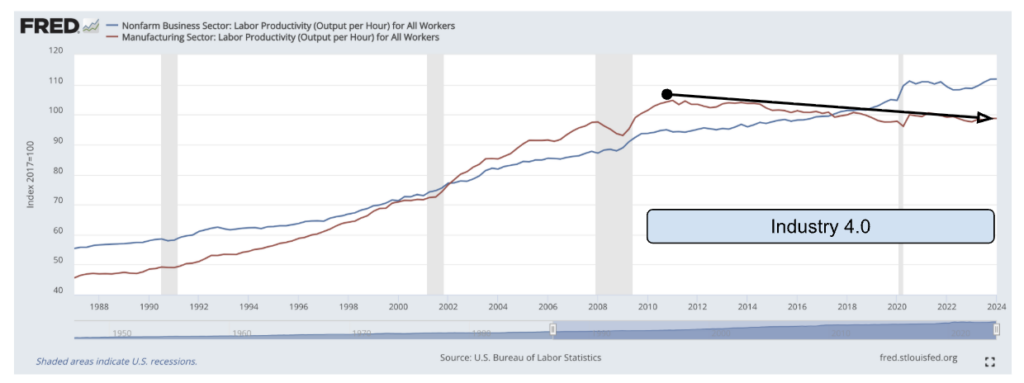
Figure 0.1.1: US Productivity of Manufacturing (red), compared to the overall business sector (excluding farming)
In figure 0.1.1 a stagnation and even a slight decline in the productivity of the manufacturing sector (red line) is apparent, which is contrasting sharply with the steady increase in overall US labor productivity (blue line).
Another trend is reshoring: the need to bring back the manufacturing industry to a country or region. The case to reshore. manufacturing is driven by global supply chain vulnerabilities, national security concerns, and the economic benefits of domestic production. A significant example is the semiconductor industry, where the CHIPS Act aims to restore U.S. production capabilities to reduce dependence on overseas suppliers, ensuring critical infrastructure resilience and boosting local economies (but obviously also to avoid high importing taxes and because of protectionism). In any case, reshoring efforts require investment in workforce development, automation, and collaboration between public and private sectors.
In Europe too, manufacturing is facing difficult times with layoffs in many sectors including the automotive and the chemical sector , just to name a few. In the last decade manufacturing – in its broadest sense – became under stress. High energy prices are one of these factors. After the invasion of Russia in Ukraine, prices peaked, but in 2023 “EU companies still face electricity prices that are 2-3 times those in the US and natural gas prices paid are 4-5 times higher” (see figure 0.1.2).
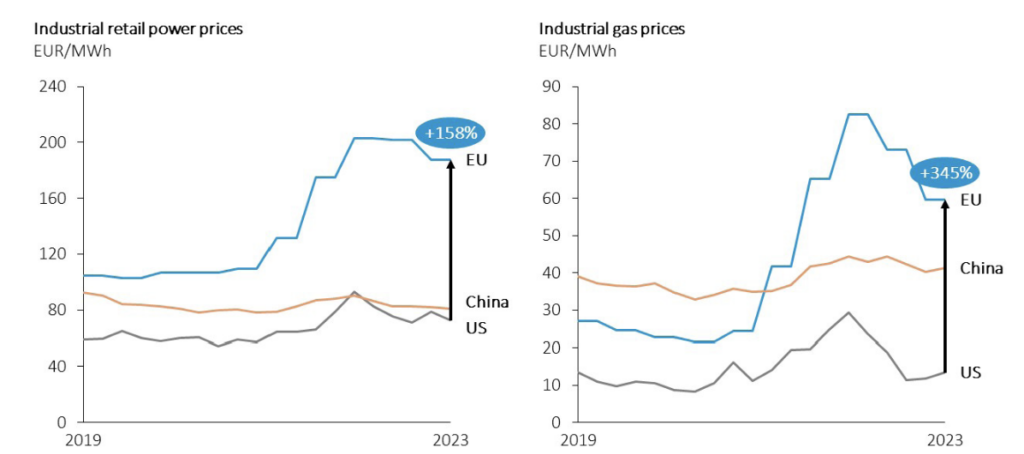
Figure 0.1.2: Gap between industrial retail power prices and industrial gas prices between US, China and the EU.
But it’s not all the fault of energy…
High salaries, stringent (sometimes even suffocating) legislation, increased competition, changing markets, and ageing infrastructure aren’t helping Europeans either. This creates a huge productivity challenge. In the FRED chart above (figure 0.1.1), we already saw that manufacturing productivity plateaued in the US, but when comparing EU productivity across all sectors, it’s evident that Europe’s productivity growth is lagging significantly behind historical rates (see figure 0.1.3). Following World War II, the EU saw robust growth driven by both increasing productivity and a growing population. However, these growth drivers have weakened; EU labor productivity, which had nearly reached US levels by 1995, has since slowed down markedly, dipping below 80% of US levels.
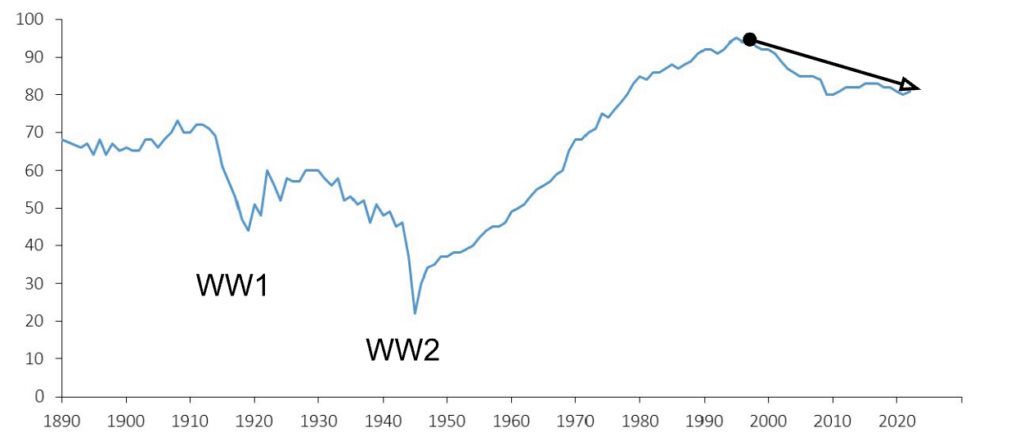
Figure 0.1.3: Labour productivity EU versus US. The vertical axis shows the index, where 100 is the US productivity. Around the two world wars we saw an expected drop in productivity, after the second world war productivity in the EU saw a steady increase to almost 100 (thus, equal competitiveness) around the turn of the millennium. However, since 2000 a steady decline can be observed.
Moreover, Europe is facing demographic headwinds unprecedented in its modern history, where GDP growth is no longer buoyed by a rising labor force. By 2040, the EU workforce is expected to decrease by nearly 2 million workers annually, and the ratio of working to retired individuals is projected to shift from 3:1 to 2:1 . In the US too, the skills gap is becoming a bigger and bigger concern .
Several macroeconomic factors surely contribute to this stagnation, but given the significant investments in ‘Industry 4.0’ technologies, such as IoT sensors, 5G, cloud computing, and machine learning, it is essential to question whether these investments are truly delivering the expected returns. There is a very interesting parallel between what we see happening today and what could be observed when electrical motors were invented and thus started the second industrial revolution. In the 1880s electricity became available with the first power plants getting build, for example the Pearl Street Station in New York City. But by early 1900s, less than 5% of US factories switched from steam to electricity, it was perceived too expensive, or factory owners didn’t see a reason to change their modus operandi . It was only after the full plant layout was redesigned (stepping away from building the plant around huge driving steam power driving shafts) and procedures and ways of thinking gradually changed, that the full power of electrical drives was acknowledged and productivity gains were found.
In an increasingly competitive and complex landscape, remaining relevant will require a paradigm shift. Similar to the introduction of electrical systems, we cannot just throw technology over the fence.
In recent years we see something changing. A perfect storm has been brewing. A combination of major supply chain disruptions, such as Covid-19 and an increasing number of geopolitical instabilities have pushed the digital agenda high on the priority list of CxOs. The advent of Generative AI has further catalyzed the hype and promises of unprecedented productivity gains. However… for some reason our manufacturing plants and critical infrastructure sector seems to be a slow mover.
A very slow mover even: pilot projects don’t seem to be able to move onwards, projects seem to take forever, it’s hard to attract and retain IT-savvy people (the so called ‘digital natives’) .
We firmly believe that automation and digitalization are critical levers for driving productivity and ensuring the competitiveness of manufacturing industries. By streamlining operations, automating routine tasks, optimizing the processes within its constraints, improving the availability and reliability of the assets and enhancing data visibility across production lines, digital technologies help manufacturers optimize use of assets, resource allocation and reduce inefficiencies. This, in turn, allows for better control over variable costs such as energy consumption and raw material usage: two factors that are becoming increasingly volatile due to global supply chain disruptions and geopolitical tensions. Advanced analytics, machine learning, and IoT-enabled monitoring systems can predict equipment maintenance needs, reduce downtime, and improve overall yield, ensuring that manufacturers can meet market demands more efficiently while minimizing waste.
Moreover, automation and digitalization address one of the most pressing challenges faced by the industry today: workforce development and retention. As manufacturing environments become more technologically advanced, the onboarding of new employees can be accelerated through digital tools such as augmented reality (AR), virtual simulations, and AI-driven training platforms. These technologies not only enhance learning by providing immersive, hands-on experiences but also help new hires reach peak productivity faster. Additionally, by automating repetitive and physically demanding tasks, manufacturers create safer and more engaging work environments, which can improve employee satisfaction and retention.
However, there is a significant caveat. Digitalization in manufacturing goes beyond simply adopting the latest technology – it’s about seamlessly integrating these advanced tools into both new and existing processes. Much like during the introduction of electrical motors during the second industrial revolution, manufacturers are hoping to apply the new tech in the existing machinery and processes without rethinking their business model as a whole (more about the different industrial revolutions in the Vignette ‘A tale of revolutions’). This is where many companies encounter roadblocks. The challenge is not the technology itself, but the cultural and organizational shifts required to fully leverage it. Traditional manufacturing environments are built on principles of safety, stability, efficiency, and long-term planning, which often conflict with the agile, experimental mindset that digital transformation demands.
Bridging this gap requires more than just technical upgrades; it involves reshaping company culture, breaking down silos, and fostering cross-functional collaboration. Resistance to change, fear of failure, and a lack of digital skills among the workforce can further slow progress. Without addressing these underlying issues, even the most cutting-edge solutions risk becoming isolated pilot projects that fail to scale across the enterprise. Successful digital transformation, therefore, hinges not only on technological innovation but on the organization’s ability to adapt, learn, and evolve alongside it.
Every industrial revolution brought much wealth to the early adaptors, those that embraced its potential and changed the way of working and reimagined the manufacturing process.
History never repeats itself, but it rhymes.
Sources:
https://fred.stlouisfed.org/graph/?g=jPKw & https://fred.stlouisfed.org/series/OPHNFB
Lamperti, F., Lavoratori, K., & Tredicine, L. (2025). From globalization to reshoring? The role of Industry 4.0 in global supply chains across Europe. Economics of Innovation and New Technology, 1–23. https://doi.org/10.1080/10438599.2025.2487145
https://www2.deloitte.com/us/en/insights/industry/oil-and-gas/chemical-industry-outlook.html
Chemical Monthly Report – CEFIC – 5th September 2024
The future of European competitiveness, Part A | A competitiveness strategy for Europe
https://us.caddi.com/resources/whitepaper/the-american-manufacturing-pressure-and-productivity-index
https://en.wikipedia.org/wiki/Pearl_Street_Station
https://www.bbc.com/news/business-40673694
https://info.themanufacturer.com/2023-manufacturing-agility-assessment